In the second year after the Hijra, the Prophet Muhammad, peace be upon him, was leading the noon prayer at the mosque of Banu Salimah in Medina when the angel Jibreel descended with a revelation.
For the first sixteen months after the migration to Medina, the Muslims had prayed facing Jerusalem, in continuity with the prophetic tradition of the People of the Book. But on this day, the revelation came: "We have certainly seen the turning of your face toward the heaven, and We will surely turn you to a Qibla with which you will be pleased. So turn your face toward al-Masjid al-Haram. And wherever you are, turn your faces toward it." (Surah al-Baqarah 2:144)
Mid-prayer, mid-rakah, the Prophet, peace be upon him, turned. The congregation behind him turned with him. The men who had been at the front moved through the rows so that the women, who had been behind them, became in front. The new direction was confirmed in the same prayer.
The mosque is still standing in Medina, and it is now called Masjid al-Qiblatayn, the Mosque of the Two Qiblas. For centuries the original Jerusalem-facing mihrab was preserved alongside the new Makkah-facing one, marking the moment of the change in stone. The building itself was the first Qibla compass in Islam, marking direction in architecture for any traveller who passed through.
A Qibla compass, in the simplest definition, is any tool that tells you the direction of Makkah from where you stand. That definition has held constant for fourteen centuries. The tools have changed many times. The purpose has not.
Why the Qibla matters
The Qibla is the direction Muslims face during prayer. It points to the Kaaba in Makkah, the cube-shaped structure that Prophet Ibrahim, peace be upon him, and his son Ismail built as the first house of worship dedicated to one God. The Quran describes it as "the first House established for mankind." (Surah Aal Imran 3:96)
From everywhere on Earth, the Qibla points to a single geographic location. The challenge of finding it is not religious. It is purely geographic. The challenge becomes interesting because the Earth is round, and the direction from Stockholm to Makkah is not the same as the direction from New York to Makkah is not the same as the direction from Jakarta to Makkah. The further you travel, the more the answer changes.
This is why the question of Qibla determination became, in the centuries after the Prophet's death, one of the central problems of Islamic science.
The Muslim astronomers who solved this problem
By the 9th century, Muslim scholars in Baghdad, Cairo, Damascus, and Andalusia had developed the most sophisticated astronomical and mathematical tradition in the medieval world. A significant part of their motivation was practical religious need. Prayer times had to be calculated. Lunar months had to be predicted. And the Qibla had to be findable from anywhere a Muslim might pray.
Al-Khwarizmi (around 780 to 850 CE), the scholar whose name gives us the word "algorithm", worked on spherical trigonometry problems that included Qibla determination among their applications. His mathematical work in Baghdad laid foundations that European astronomers would build on six centuries later.
Al-Biruni (973 to 1048 CE), perhaps the greatest polymath of the Islamic Golden Age, calculated Qibla directions for dozens of cities with remarkable accuracy. He also famously measured the Earth's circumference using a method requiring only a mountain in modern Pakistan and a clear horizon, arriving at a figure within one percent of the modern measurement. His Qibla calculations were used by mosque architects across the Muslim world for generations.
Al-Khalili (around 1320 to 1380 CE), working in Damascus, produced extensive Qibla tables that allowed a traveller to look up the direction of Makkah from any of dozens of cities without performing the calculation themselves. These tables were the medieval equivalent of a Qibla app, distributed in manuscript form across the Muslim world.
This was the science of finding the Qibla. It was done with quadrants, with star tables, with mathematical reasoning so advanced that European universities were still translating these works three centuries later. Every Muslim who picks up a phone today to find the direction of Makkah is the inheritor of this tradition.
The instruments they built
Astrolabes. From the 9th century onward, Muslim instrument makers produced astrolabes engraved with Qibla calculations. These were beautiful and complex bronze instruments used to determine direction by measuring the position of the sun and stars. Some surviving astrolabes from the 11th and 12th centuries still produce accurate Qibla bearings for cities marked on their faces. They were the smartphones of medieval Muslim astronomers, and the surviving examples in museums in Istanbul, Cairo, and Tehran are among the most beautiful scientific objects ever made.
Qibla indicators (Qibla numa). A specific instrument, the Qibla numa, emerged from the Ottoman tradition. These were portable devices combining a magnetic compass with a list of bearings for major cities, allowing travellers to find the Qibla from any of them without recalculating. They were sold at markets in Cairo, Istanbul, and Damascus. They were the direct ancestors of every modern dedicated Qibla compass.
Mihrabs as architectural Qibla indicators. Every mosque in the world built since the early Islamic centuries has a mihrab, a niche in the wall that indicates the Qibla. The earliest mosques outside Arabia were sometimes built with imperfect calculations and later corrected, but for several centuries the architecture itself has been the most reliable Qibla compass any city has, fixed in stone and visible to anyone who walks in.
Pocket magnetic compasses. Once magnetic compasses became widespread in the Muslim world from roughly the 13th century onward, pocket Qibla compasses became common. Hajj pilgrims carried them. Traders along the Indian Ocean shipping routes carried them. They were the working tool of any Muslim who travelled far from home.
How modern Qibla compasses work
There are two fundamentally different approaches.
Magnetic compasses with Qibla calibration. A traditional magnetic compass detects the Earth's magnetic field. The compass card is printed or marked with the Qibla bearing for one or more cities. The user points the north arrow at magnetic north, then reads off the Qibla direction from the printed dial. Simple, reliable, no battery. The disadvantages are magnetic interference and the need to know your reference city.
GPS-based Qibla devices. A GPS device knows your exact geographic location and calculates the bearing to Makkah using the same spherical geometry al-Biruni used a thousand years ago. Smartphone Qibla apps work this way, as do smart watches, smart rings, and haptic wearables. The advantages are accuracy and the ability to work anywhere on Earth without preset references. The disadvantages are battery dependency and the need for GPS signal.
The most accurate modern Qibla compasses use GPS to determine the user's location and the device's internal magnetometer or gyroscope to determine which way the device is pointed. The two combined produce a reading accurate to within a few degrees, which is well within the tolerance scholars consider valid for prayer.
The categories of Qibla compass available today
1. Traditional analog Qibla compasses. Magnetic compasses with printed Qibla bearings. Available from Islamic bookshops for $5 to $30. The direct descendants of the Ottoman Qibla numa.
2. Digital prayer clocks with Qibla. Tabletop or wall-mounted clocks (Alfajr is the most established brand) that display prayer times, announce the adhan, and include a Qibla indicator. Useful at home.
3. Qibla apps on smartphones. Free or low-cost apps including Muslim Pro, Athan, IslamicFinder, Pillars, and the Qibla feature in Google Maps. The most used Qibla tool in the world today. Limitations include battery, screen distraction during prayer, and magnetic interference from the phone itself.
4. Smart watches and smart rings. Apple Watch, most Android wearables, and dedicated Islamic wearables (iQibla, Equantu) include Qibla functions. Generally screen-based, often combined with dhikr counting, prayer times, and other features.
5. Haptic Qibla devices. A smaller category. The device vibrates when pointed toward the Qibla rather than showing an arrow on a screen. No light, no audio, no need to look. This is the category we make.
What we built and why
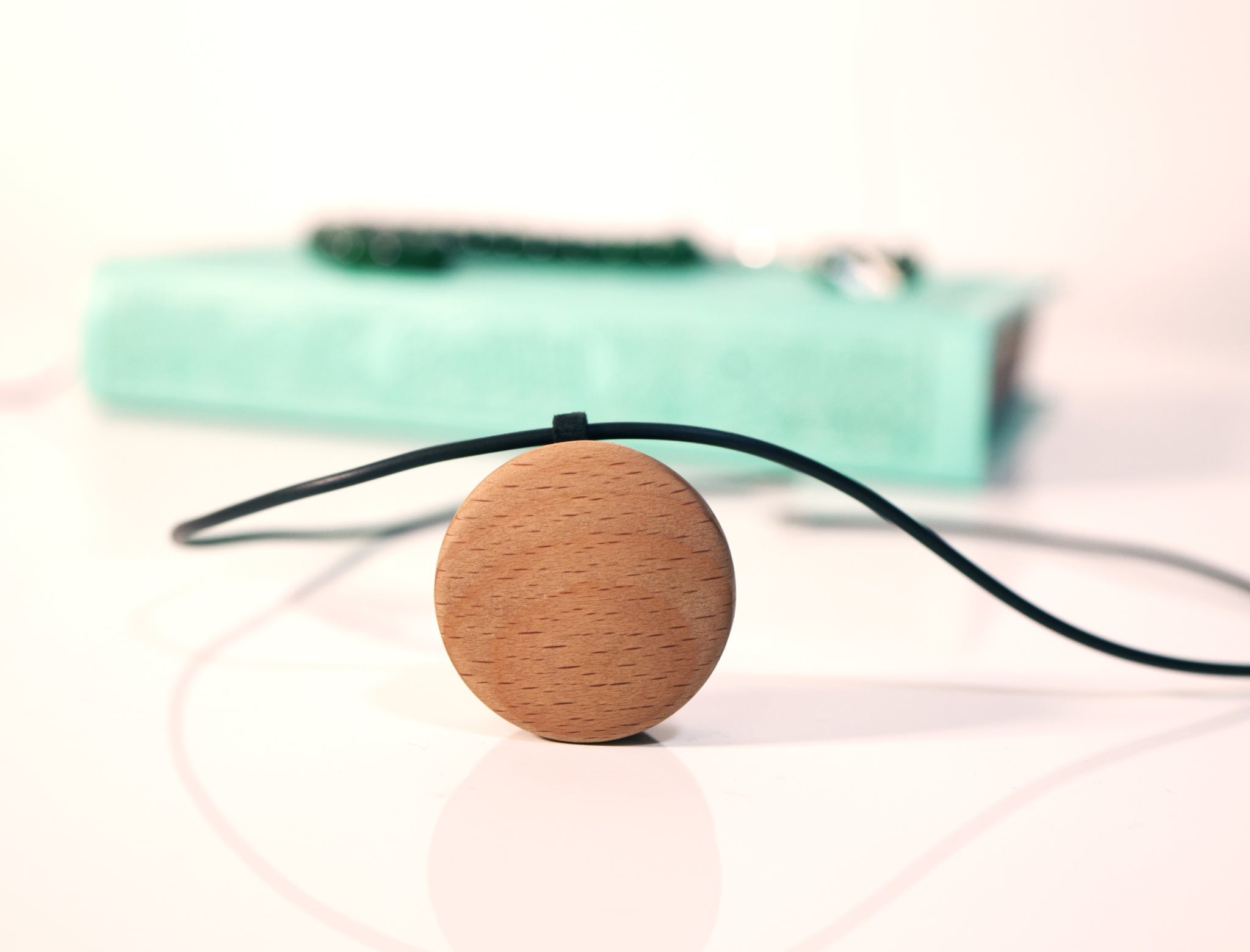
We make haptic Qibla compasses at QiblaSense. The pendants and prayer beads we produce vibrate when they are pointed toward Makkah and stop when they are turned away. There is no screen and no audio. The wearer holds the pendant, turns slowly, and feels a steady pulse when they face the Qibla.
We built them for the same reason the medieval astrolabe makers built theirs. The available tools had limitations. A phone screen distracts during prayer. A magnetic compass requires you to read a needle and remember a bearing. A smart watch lights up at the wrong moment. A wall mihrab is fixed to one building. We wanted a device that did the one thing the medieval astrolabe was made to do, in modern form, in a small object you wear, that disappears until the moment you need it.
It is not for everyone. People who want a screen full of features should buy a smart watch or smart ring. People who want the cheapest possible solution should download a free app. People who want a single-purpose device that vibrates silently when they face the Qibla, that works without setup, and that they can wear into a mosque or a hotel room or a meeting room without anyone noticing, may want to look at what we make.
You can see the range at qiblasense.com.
How to choose the right Qibla compass for you
If you mostly pray at home in a fixed room, you do not need a dedicated Qibla compass at all. Find the Qibla direction once using any app, mark it on the floor or a piece of furniture, and you are done. The mihrab in your mosque has already done the work for the building.
If you travel occasionally, a free Qibla app on your phone is enough. Make sure you know how to calibrate it and recognise when it is being interfered with.
If you travel frequently or for prayer-heavy trips (Hajj, Umrah, multi-city business travel, work in industries that take you to remote sites), a dedicated device adds reliability when your phone is dead, lost, or out of reach. The right device depends on personal preference. People who want screens and many features tend toward smart watches. People who want minimalism and silence during prayer tend toward haptic devices. People who want the simplest possible tool tend toward magnetic compasses.
If you or someone you pray with is blind or visually impaired, a haptic Qibla device or an audio-based Qibla app paired with a screen reader is significantly more independent than asking a sighted companion before each prayer.
A note on accuracy
Islamic scholarship is generous on small directional deviations. The recognised position across all major schools of thought is that facing the Qibla means facing it as best as you reasonably can. Several hadith confirm that small deviations do not invalidate the prayer. "What is between the east and the west is Qibla," the Prophet, peace be upon him, said (Jami at-Tirmidhi), teaching the people of Medina, for whom Makkah lay to the south. The principle generalises.
The point of a Qibla compass is not engineering perfection. It is to help you pray with intention and reasonable accuracy, especially in unfamiliar places. The Prophet's companions turned mid-prayer when the news arrived. Al-Biruni calculated the Qibla from anywhere on Earth using a quadrant and his mind. Today the same calculation runs in the background of a free app or a small wearable that vibrates in your hand. The instruments have improved. The intention has not changed.
QiblaSense is a Stockholm-based brand making haptic prayer compass devices that vibrate to point toward the Qibla. We write about prayer, navigation, and the long history of how Muslims have solved the same question for over a thousand years. Visit qiblasense.com to learn more.