There is a small mosque in Medina with two prayer niches. One faces north toward Jerusalem. The other faces south toward Makkah. It is called Masjid al-Qiblatayn, the Mosque of the Two Qiblas, and it marks the place where, in the second year after the Hijra, the Prophet Muhammad, peace be upon him, was leading the noon prayer when news of the Qibla change arrived.
The revelation came in Surah al-Baqarah: "Turn your face toward al-Masjid al-Haram, and wherever you are, turn your faces toward it." The Prophet, peace be upon him, did exactly that. Mid-prayer, mid-rakah, he turned. The congregation behind him turned with him. Some of them stepped through the rows so that the women, who had been behind them, became in front, and the prayer continued without breaking. The mosque is still standing in Medina, and for centuries the building preserved both prayer niches, one pointing toward Jerusalem and the other toward Makkah, marking the moment of the change in stone.
There is something instructive in this story for any Muslim who has ever stood in an unfamiliar hotel room and wondered which way to face. The Qibla is not a fixed point in your house. It is a direction you carry, and from anywhere on Earth you adjust to it. The companions did it on news that travelled by foot. We do it now in airports, on trains, in conference centres and rented apartments. The question has not changed. Only the tools have.
This guide walks through the practical methods Muslims use to find the Qibla while travelling, beginning with what the Prophet, peace be upon him, taught about prayer on the road, and ending with the dedicated devices that have replaced the astrolabe and the pocket compass.
"The whole earth has been made for me a mosque"
In one of the most quoted hadiths on travel and prayer, the Prophet, peace be upon him, said: "I have been given five things which were not given to anyone before me. The whole earth has been made a place of prayer and a means of purification for me, so whenever the time of prayer comes for any one of my Ummah, he should pray." (Sahih al-Bukhari)
This single line shaped the way Muslims have travelled for over a thousand years. There is no need for a built mosque, no need for a particular surface, no need for permission. What is needed is the direction. The Qibla is the only consistent geographic requirement for prayer, and finding it is the threshold of every prayer made far from home.
The early companions and successors made this work in conditions far harder than ours. Caravans crossing the Arabian Desert, traders sailing the Indian Ocean shipping lanes, scholars travelling from Andalusia to Khurasan, all prayed at every halt, often using nothing but the position of the sun and the orientation of the wind. The tools we have today are a luxury they did not have. The duty is the same one they carried.
Method 1: Use the sun, the method of the early travellers
The most ancient method of orientation on Earth is the sun. It rises in the east, sets in the west, and is roughly south at solar noon in the Northern Hemisphere (roughly north at solar noon in the Southern Hemisphere). From any of these, you can estimate the Qibla relative to where you are.
If you know that the Qibla from Stockholm is south-southeast, and you can see roughly where the sun is, you have your bearing. The same logic worked for travellers walking from Damascus to Makkah a thousand years ago, and it works for anyone today standing in a hotel garden at sunrise.
The limitation is cloudy days, windowless rooms, and night prayers. The Prophet, peace be upon him, accepted reasonable effort. If you cannot see the sun and you cannot find your direction with certainty, scholars across all the major schools agree that praying with sincere intention in your best estimate is valid.
Method 2: Follow the orientation of mosques
This method is older than the magnetic compass. Wherever a mosque has been built by Muslims, its mihrab faces the Qibla. The earliest mosques outside Arabia were sometimes built with imperfect calculations and later corrected, but for several centuries the architecture itself has been a reliable Qibla indicator.
In any city with even a small Muslim community, find a mosque on a map, look at the orientation of its long axis, and you have your bearing. Google Maps lists mosques in nearly every city in the world. From your hotel, the building outline gives you a usable reference for every prayer of your trip.
This is also the courteous method. Walking past a mosque on a Friday in an unfamiliar city, glancing at its orientation, and praying Asr two streets away in a small hotel room connects you to the same direction the congregation is facing. There is something quiet about that continuity.
Method 3: Smartphone Qibla apps and their limitations
The most-used Qibla tool in the world today is a free smartphone app. Muslim Pro, Athan, IslamicFinder, Pillars, and the Qibla feature inside Google Maps all use the phone's GPS and magnetometer to calculate the bearing to Makkah.
When they work, they work well. When they fail, they fail in ways that are not always obvious. Smartphone compasses are sensitive to magnetic interference. The metal frame of the bed, the laptop on the desk, the steel reinforcement inside hotel walls, even a magnetic phone case, can throw the reading off by tens of degrees. If the arrow swings around as you walk across the room, the compass is being interfered with, and you should not trust it.
The fix is to calibrate the phone by waving it in a figure-eight motion, to step away from electronics, and if possible to cross-check by walking outside. The deeper issue is that during prayer itself, having a phone in front of you is a different kind of distraction. Notifications. The temptation to glance. The bright screen in a dim room. Many Muslims who travel often choose to find the Qibla once before prayer and then put the phone aside.
Method 4: A dedicated Qibla compass
For travellers who pray five times a day across multiple time zones, who go on Hajj or Umrah, or who simply prefer to keep their phone out of the prayer space, a dedicated Qibla device removes friction.
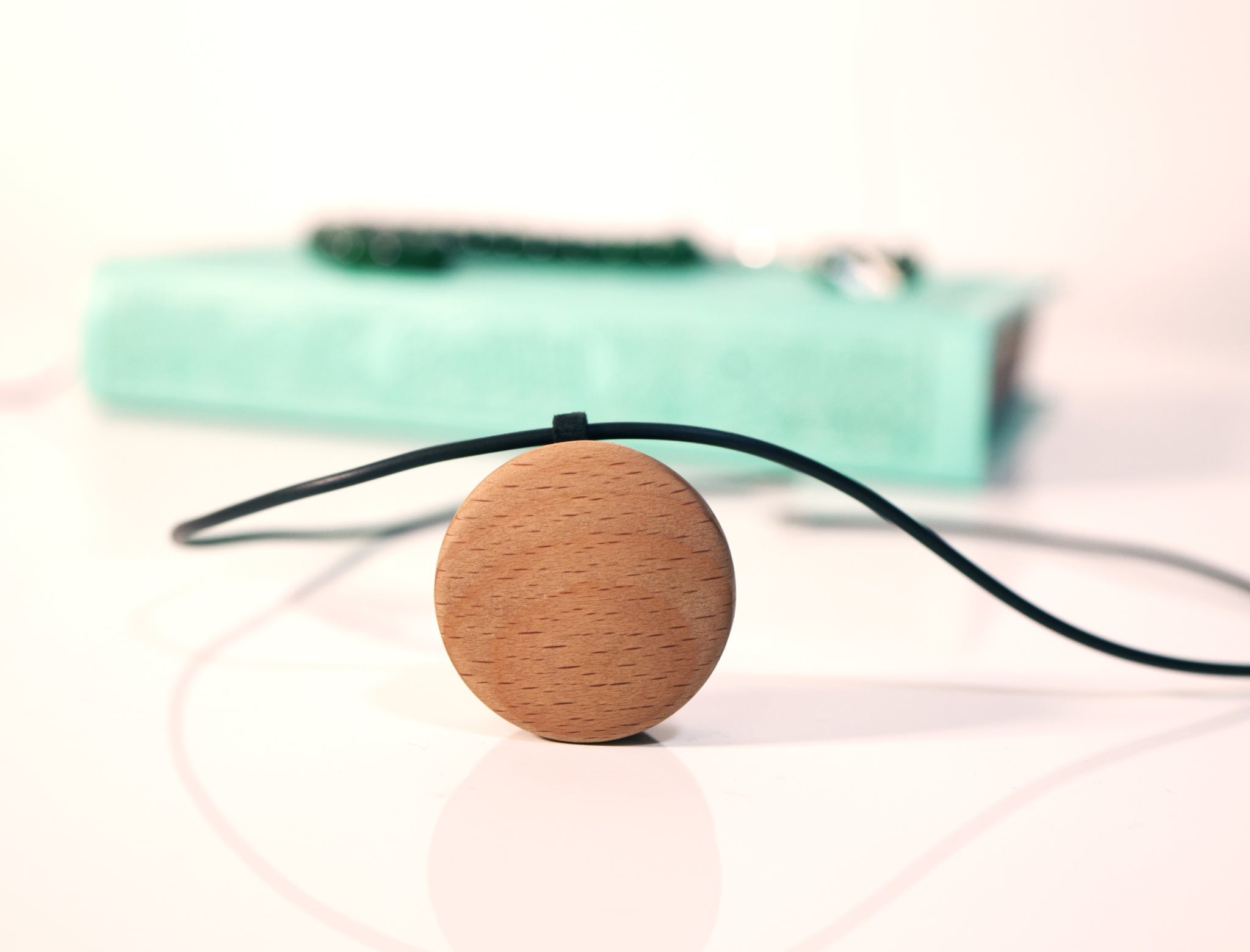
We make haptic Qibla compasses at QiblaSense, and the reason we make them is honest. We wanted a device that vibrates when it is pointed toward the Qibla rather than showing an arrow on a screen. No screen, no light, no need to look. The pendant or prayer beads sit in your hand or hang from your neck, you turn slowly, and you feel a steady pulse when you face Makkah. The pulse stops when you turn away.
It was designed for three kinds of people, and they have remained our most consistent customers. Travellers who pray in many unfamiliar rooms and want a device that just works without setup. Muslims who prefer prayer without a screen in front of them. And blind and visually impaired Muslims who, before this kind of device existed, often had to ask a sighted person to confirm the direction before every prayer in a new space.
We built the thing we wished existed when we travelled. There are other dedicated Qibla devices on the market. Alfajr makes prayer watches with a Qibla indicator. iQibla makes smart rings and watches. Traditional magnetic Qibla compasses are sold in Islamic bookshops everywhere. The right tool depends on whether you want a screen, audio, a small wearable, or nothing more than a needle and a printed bearing. Ours is for people who want the most a device can do while staying silent and unseen in the moment of prayer.
If you are curious about our version, you can see it at qiblasense.com.
Method 5: Ask a Muslim, anywhere
The oldest method, and still one of the most underrated. Muslim communities exist in nearly every major city in the world, including ones where you would not expect them. Hotel staff in Gulf countries, Southeast Asia, North Africa, and most major Western cities will either be Muslim themselves or know exactly where the nearest mosque is.
Walking up to the front desk and asking "Which way is the Qibla, please?" is faster than any app, creates more goodwill than most travellers expect, and reflects something the Prophet, peace be upon him, recommended often, which was to ask the people of knowledge when you do not know.
Edge cases worth preparing for
Praying on an aircraft. Scholars differ on the level of precision required. The pragmatic consensus is that the pilgrim faces the Qibla at the start of prayer, and continued movement of the plane does not invalidate it. Several airlines (Saudia, Emirates, Qatar Airways, Turkish Airlines) display the Qibla on the in-flight entertainment system or near the galley.
High latitudes. In far-northern places like Lapland in the summer, the sun does not set and prayer-time apps sometimes produce unusable schedules. The Islamic Society of North America and several European fiqh councils have published rulings on alternative timing methods. Save these before travelling.
Hotels without windows or natural light. A bathroom prayer is sometimes the only option for business travellers with back-to-back meetings. Use a Qibla app or device before entering, then carry the bearing in.
A small habit to build before your next trip
- Install one Qibla app on your phone and learn how to calibrate it. Test it at home where you know the correct direction.
- Note the approximate Qibla direction from your destination city before you fly. A 30-second search saves time on arrival.
- If you travel often, consider a dedicated device. The point is independence from your phone battery, not the brand.
- Memorise the sun method. It has worked for a thousand years and will get you out of a bad hotel room and a dead battery on the same trip.
The Qibla has been found by Muslims in deserts, on ships, in mosques without compasses, and in places where no Muslim had ever prayed before. The Prophet's companions turned mid-prayer when the news arrived. We carry a tradition of adjustment, and the tools we use today are part of a long history of solving the same simple problem.
QiblaSense is a Stockholm-based brand making haptic prayer compass devices designed for Muslims who travel. We write about prayer, navigation, and the small frictions of practising Islam in modern life. Visit qiblasense.com to learn more.