The Prophet Muhammad, peace be upon him, said: "Exchange gifts and you will love one another." (Al-Adab al-Mufrad of Imam al-Bukhari)
This short hadith is the foundation of a tradition that runs through every culture in the Muslim world. Gifts are not just objects. They are a way of carrying affection across distance and across moments that matter. Few moments matter more than the day a friend or family member leaves for Hajj.
In many Muslim communities, the weeks before a relative's departure are filled with small ceremonies. People come to the house to pray with the pilgrim, to ask for dua at the Multazam and at Arafat, to bring something small the pilgrim will use during the journey. When the pilgrim returns, the welcomes are even larger. Sweets are distributed. Children gather for blessings. The Hajji's house carries something of Makkah back with them, and the community comes to receive it.
This guide is for the people preparing to send someone they love on this journey. The gifts here are organised across the three phases: the weeks of preparation before departure, the pilgrimage itself, and the return home. The ones we recommend are the ones we have seen pilgrims actually use and remember, not the decorative gifts that sit in closets.
Before the journey: gifts that help with preparation
1. A high-quality Ihram set with a storage bag. Ihram is the simplest garment a Muslim will ever wear and one of the most significant. Two pieces of seamless white cloth, the same for the wealthy and the poor, for the king and the labourer, a uniform of equality before Allah. The Prophet, peace be upon him, wore his Ihram for the Farewell Hajj and delivered his final sermon in it, the sermon in which he declared that no Arab has superiority over a non-Arab and no white person has superiority over a black person except in piety. A good Ihram set is something a pilgrim packs and unpacks many times during the trip. A waterproof storage bag protects it. A second set, in case the first is soiled, is one of the most practical preparation gifts.
2. A pocket-sized dua book. Hajj has many recommended supplications at specific stations. The dua at Safa and Marwa, the dua at Arafat, the standing at Muzdalifah, the stoning of the Jamarat. Most pilgrims want a small reference they can carry through Tawaf and Sa'i in their pocket. Look for one in Arabic with transliteration and translation, ideally with a soft leather cover that handles being slipped in and out of pockets in the heat.
3. A travel prayer mat. Folding prayer mats designed for travel are smaller, thinner, and made of materials that pack down without holding wrinkles. Some come with a built-in Qibla compass on the corner. A good travel prayer mat lasts for years and gets used long after Hajj is over, on every business trip and family vacation that follows.
4. A pilgrim's journal. Aisha, may Allah be pleased with her, was known for remembering and reciting in detail the events of the Prophet's life, peace be upon him. Many of our most precious narrations of his Hajj come from companions who paid careful attention. Hajj is intense and emotionally dense, and most pilgrims wish afterwards they had written more down. A simple hardcover notebook with space to record duas made, places visited, and reflections becomes a treasured object for decades. Some families pass these journals to children and grandchildren.
For the journey: gifts that solve real problems
5. A foot care kit. This is the gift most pilgrims tell us they wished they had been given. The Sa'i between Safa and Marwa is seven circuits across roughly three kilometres of hard marble. The walks between hotels and the Haram, between Mina and Arafat, accumulate over days. Blisters, dry skin, and tired feet are universal. A small kit with quality blister plasters, foot cream, comfortable cotton socks, and antibacterial wipes is worth more than almost any traditional gift.
6. A collapsible insulated water bottle. Pilgrims drink Zamzam constantly during Hajj. The well of Zamzam itself has flowed since the time of Hajar, mother of Ismail, when she ran seven times between the hills of Safa and Marwa searching for water for her infant son, and the water sprang up at his feet. The Sa'i that every pilgrim performs today retraces those same steps. To carry Zamzam in your hand throughout your prayers is to carry that story. An insulated 500 to 750 ml bottle that keeps water cold in the desert heat, and folds flat or attaches to a belt, is used many times every day.
7. A high-capacity power bank with multiple cables. Pilgrims need their phones for prayer times, family calls, location pins for finding their tents at Mina, and translations. A 20,000 mAh power bank with USB-C, Lightning, and Micro-USB cables means the pilgrim is not searching for an outlet on a long day at the Haram.
8. A Qibla compass that works without a phone. This is a gift category we know well, because it is the one we built our company around.
Pilgrims at Mina, Arafat, and Muzdalifah pray in tents, in crowds, and in unfamiliar spaces, sometimes with phones turned off or out of reach. A pilgrim arriving at their tent in Mina at Fajr, exhausted after a day of standing at Arafat, does not want to open an app, calibrate a compass, and stare at a screen before bowing their head. They want to know which way to face, and then they want to pray.
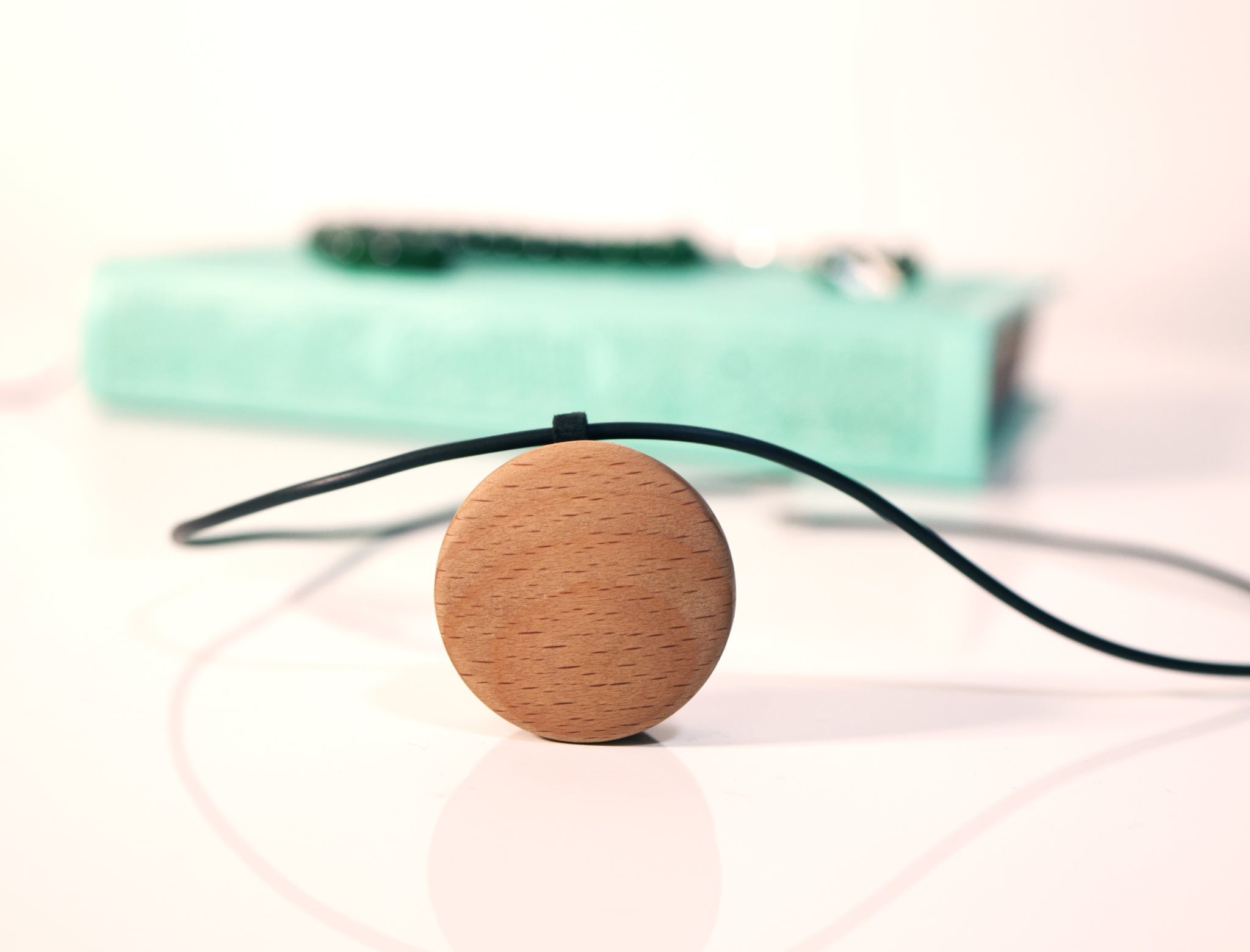
We make haptic Qibla compasses at QiblaSense for exactly this kind of moment. The pendant vibrates when it is pointed toward the Qibla and stops when it is not. The pilgrim does not need to look at a screen, does not need to ask anyone, does not need to wait for GPS to lock indoors. It was designed in conversation with members of our community who had been on Hajj and described the specific friction of finding the Qibla in a tent at Mina, in an unfamiliar mosque, in the crowd at the Haram when the call to prayer is sounding and there is no time to dig through pockets for a phone.
Several of our customers have taken our devices on Hajj and Umrah, and the feedback has consistently been that the device sits quietly until it is needed and disappears the rest of the time. For a Hajj gift, that is the bar.
You can see the version we made for pilgrims at qiblasense.com.
9. A money belt or travel pouch. Pilgrims carry passports, visas, Hajj documents, and currency, and traditional pockets are awkward inside Ihram. A flat, soft, RFID-blocking pouch worn under the Ihram or in a hidden inside pocket is practical and security-conscious.
After the return: welcome-home gifts and traditions
10. A printed photo book of the journey. Offer to put one together once the pilgrim returns. Photos from the Haram, from Mina, from Arafat, paired with quotes from their dua book and notes from their journal, make a keepsake the pilgrim will keep on a coffee table for years.
11. A Zamzam water decanter. Many pilgrims return with several litres of Zamzam water and pour small amounts for family and guests on special occasions. The Prophet, peace be upon him, said: "The best water on the face of the earth is the water of Zamzam. In it is food for the hungry and a cure for illness." (Sahih al-Targhib) A glass or metal decanter that keeps it clean and accessible is a quietly traditional welcome-home gift, and it elevates the moment when the Hajji pours a small cup for a guest.
12. A framed plaque with the Hajj date in the Islamic and Gregorian calendars. Simple, calligraphic, and the kind of thing that sits on a shelf for decades. Some cultures hang the date above the doorway of the Hajji's house. It marks the year the pilgrim returned, and it stays in the family memory long after the photos fade.
What to avoid
Three categories that do not land well, in our experience:
Anything heavy. Pilgrims pack within strict airline weight limits. Heavy gifts get left behind or cause stress.
Anything that requires a specific charger the pilgrim does not already own. Saudi Arabia uses Type G plugs, the same as the UK. New devices with unfamiliar chargers become hassles in a hotel room at 2 am.
Generic Islamic decorative items. A pilgrim about to undertake the journey of their life does not need another wall plaque. Focus on things that solve problems during the actual trip.
The gift you cannot wrap
There is one thing every pilgrim wants to receive that is not on this list, and it is more valuable than anything you can wrap. Ask the pilgrim to make dua for you at the Multazam, at the Hijr of Ismail, at Arafat. Hand them a small list, or just one name and one request, written on a folded piece of paper.
The Prophet, peace be upon him, taught that dua at these places is answered in a special way, and to be remembered there by someone who loves you is among the quietest and deepest gifts in the religion. The Hajji who carries your name to Arafat is carrying a gift no shop sells.
The gifts in this guide are useful. That last request is sacred.
QiblaSense makes haptic prayer compass devices for Muslims who travel for work, family, and pilgrimage. We write about pilgrimage, prayer, and the questions families ask each other when one of them is preparing for Hajj. Visit qiblasense.com to learn more.