Islamic Gifts That Actually Mean Something: How QiblaSense Compares to Every Other Option
Finding the right Islamic gift is harder than it looks. You want something that honours the person's faith, feels personal rather than generic, and does not end up in a drawer by Ramadan's end. This guide walks through the four kinds of gifts most people consider for the Muslims in their lives, names the products honestly (including our competitors), and explains where QiblaSense fits and why we believe it is one of the most meaningful choices you can make.
Whether you are shopping for an Eid present, a wedding, a new home, a returning Hajj or Umrah pilgrim, a graduation, a revert to Islam, a birthday, or simply because gift-giving in Islam needs no occasion at all, this is written for you.
Why Islamic Gifts Are Hard to Get Right
Gift-giving sits close to the heart of Muslim life. The Prophet Muhammad (peace be upon him) said, "Give gifts and you will love one another" (تَهَادُوا تَحَابُّوا), a narration recorded by Imam al-Bukhari in Al-Adab al-Mufrad (number 594) and graded hasan (fair) by al-Albani. Unlike many Western traditions, Islamic gifting does not wait for a calendar date. A gift is an expression of love, gratitude, and respect at any time.
That is exactly what makes it hard. A meaningful religious gift has to clear three quiet tests: it should be halal in substance, given with sincere warmth, and it should suit the beliefs and taste of the person receiving it. Scholars note that the same object can be an ordinary gift or an "Islamic" one depending on the care behind it. A box of dates, an attar bottle, a leather notebook: each becomes special not because of a label but because of the thought.
The trouble is that most Islamic gifts fall into two traps. Either they are beautiful but not useful (wall art that hangs unnoticed), or useful but not beautiful (a plastic gadget that feels like an impulse buy). The best gifts are both. Let us look at the real options.
Option One: Traditional Islamic Gifts
These are the classics, and they are classics for a reason.
Prayer beads (tasbih / subha). A quality set of prayer beads in sandalwood, oud wood, or gemstone is timeless. Traditional tasbih range from a few dollars for basic sets to premium handcrafted oud or agate strands. Strengths: deeply personal, endlessly used, permissible and encouraged. Weakness: on their own they do only one thing, and a cheap set feels like an afterthought.
Attar and oud perfume. Fragrance is beloved in Islamic tradition, and alcohol-free attar (oud, rose, musk) makes a sophisticated gift. Kaaba-inspired attar and tasbih gift sets are widely sold. Strengths: sunnah-friendly, luxurious, unisex options. Weakness: scent is personal and easy to get wrong, and it is consumable rather than lasting.
Quran gift sets, Islamic wall art, and dates. A beautifully bound Quran, metal or glass Arabic calligraphy wall art (Ayatul Kursi pieces commonly run from around $60 to $260), and luxury date boxes from names like Bateel are all popular. Strengths: dignified, appropriate for almost anyone. Weaknesses: wall art depends heavily on the recipient's decor taste, and dates, while lovely, are quickly gone.
Islamic jewellery and name necklaces. Personalised Arabic name necklaces and calligraphy pendants (often $20 to $80 in silver or gold plate) are among the most searched Muslim gifts. Strengths: personal, wearable. Weakness: purely decorative, and gender-specific.
Option Two: Phone Apps
The most popular Qibla and prayer tools in the world are free apps. According to Muslim Pro's own About Us page, the app has "over 190 million downloads worldwide" (a figure it reports having surpassed by Ramadan 2026, having launched in 2010), and other apps like Athan and Qibla Finder are widely used. They give prayer times, Qibla direction, a digital tasbih, and Quran text.
As a gift, though, an app has an obvious problem: you cannot really give one. It is free, it lives on a screen, and it asks the user to pull out a phone, unlock it, and hold it up before every prayer. That is functional, but it is not a present, and it is not private. For anyone who finds reaching for a glowing phone before salah distracting, an app is a tool, not a gift.
Option Three: Smart Muslim Tech (iQibla, Weslamic, Equantu and others)
This category has grown fast, and credit where it is due: these brands brought Muslim wearables into the mainstream.
iQibla is the best known. According to iQibla's own About Us page the company was established in 2019 by entrepreneur Jack Shao, and its devices are produced by the Shenzhen-based manufacturer Umeox Innovations Co., Ltd. iQibla popularised the "Zikr Ring," which it released in 2021 and markets as "the world's first Muslim smart ring," debuting it at GITEX Technology Week 2021 in Dubai. It is a smart tasbih ring with an OLED display that counts dhikr, vibrates at 33/66/99/100, and shows prayer times. Their range is broad: Zikr rings from around $39 to $149, Qwatch Islamic smartwatches from about $79 to $119, a Qphone at roughly $49, and a Salat Counter. Per an iQibla press release, the Zikr1 ring is "made from Aluminum Alloy," more durable than the zinc alloy of earlier versions, with a Bluetooth module, vibration motor, and 40mAh battery; rings charge via USB-C or a charging case and pair with the "iQIBLA Life" app for full features. Genuine strengths: feature-rich, affordable, widely available on Amazon and elsewhere. Their published after-sales terms note that within the warranty period covered products are replaced rather than repaired.
Weslamic makes the "iTasbih" smart dhikr ring line. Their rings are lightweight ABS resin (around 6 to 7 grams), come in multiple interchangeable sizes, connect to the Weslamic app via Bluetooth, and charge over USB-C. Prices run roughly $39.99 to $127. Weslamic's own guidance places a quality smart tasbih ring at $40 to $120. They offer a 33-day refund window and manufacturer warranty, with support run from a China contact number. Strengths: comfortable, gift-packaged, honest content marketing. It is an electronics-first product.
Equantu, per its own About Us page, is "Equantu Technology Pte. Ltd.," founded in 2006, "headquartered in Singapore with a factory in China," and has delivered products "to over 170 countries worldwide," producing "over 2 million Quran speakers annually." It is strong in Quran speakers and azan clocks, typically $43 to $72, plus zikr rings and bukhoor burners. Great for the home; less a personal keepsake.
There are also smart prayer mats such as Sajdah, described by The National (May 2023) as the creation of Qatari inventor Abdulrahman Saleh Khamis, made by Doha-based Thakaa Technologies and awarded a gold medal at the 48th International Exhibition of Inventions in Geneva. It retailed at $499 and is excellent for teaching salah to children and reverts, though it is a large, screen-and-speaker learning device rather than something carried close.
The honest summary: this category is capable and good value. What it is not, generally, is quiet, natural, or heirloom-feeling. These are metal-and-plastic electronics with screens and companion apps, made largely in the same manufacturing ecosystem, and most are designed around counting and notifications rather than beauty.
Option Four: QiblaSense
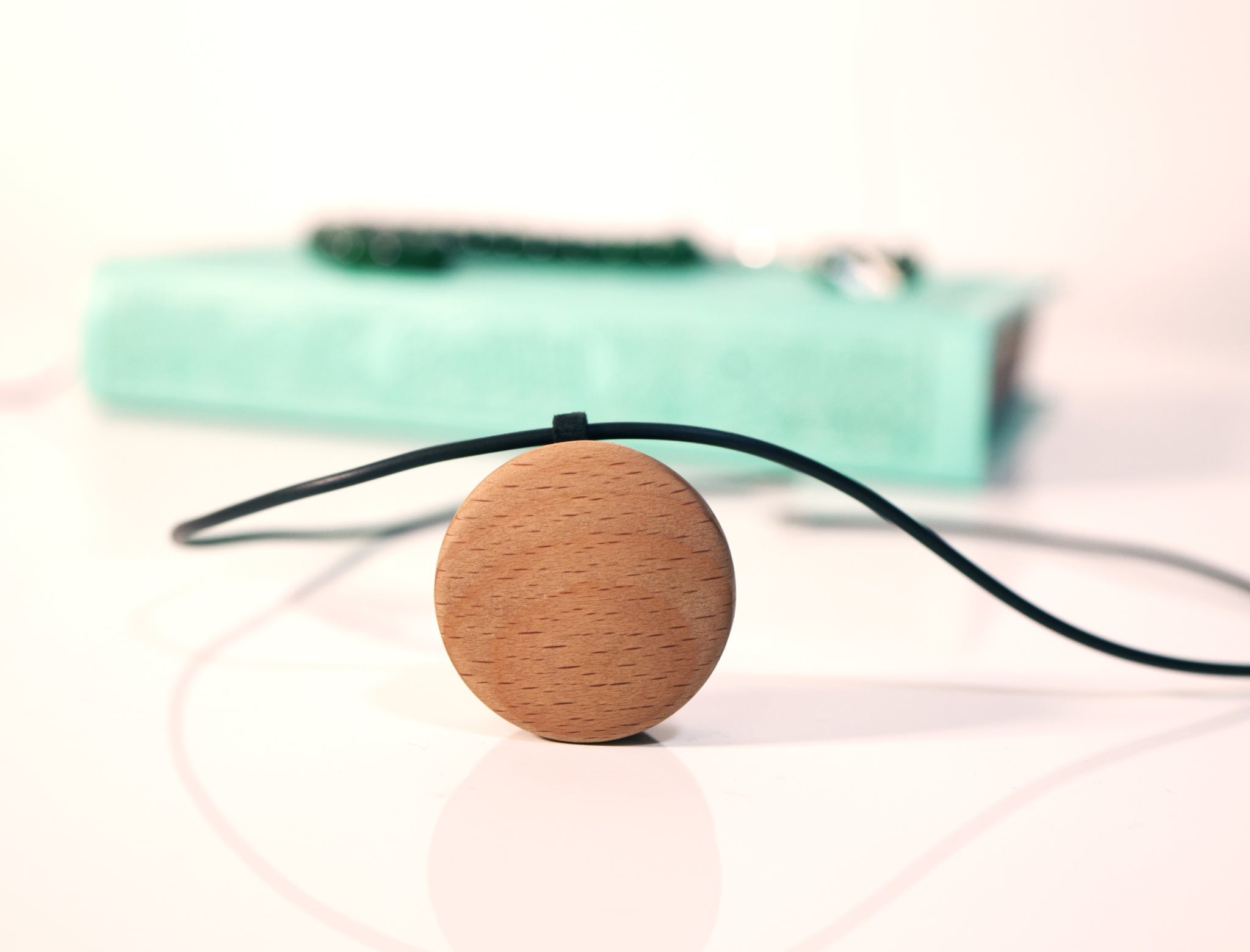
QiblaSense sits deliberately in a different place. It is a smart prayer compass, made in two forms: a necklace (pendant) worn close to the heart, and a subha (prayer beads) held in the hand with 33 beads for zikr. You press it, turn slowly, and it gives a discreet double vibration when you face the Qibla. A soft pulse also reminds you at each of the five prayer times.
Crucially, it works standalone once synced, no phone in hand, no screen to look at. Its own product pages state it "works standalone once synced, no phone needed" and "charges via USB-C." You set it up once with the app, then simply use it.
Where it truly departs from the tech category is in materials and design. QiblaSense is designed in Sweden and handcrafted in natural materials:
- The Sunlight Guide to Prayer collection uses light Nordic hardwoods, typically oak, ash, and beech, each piece unique in its grain.
- The Mataaf Path to Prayer collection uses a natural white stone finish inspired by the marble of the Mataaf around the Kaaba, with sandalwood and tigerstone subha options.
- The Custom Luxury Collections, including the Silver Compass of Devotion and the Radiant Path to Jannah, feature silver, amber, and semi-precious stones in limited quantities.
Every QiblaSense ships in a premium Kaaba-styled black and gold gift box, so the unboxing itself feels like an occasion. Prices run from around 749 SEK to 2,149 SEK for the main range (roughly $70 to $215), with the bespoke luxury pieces higher. And through its Ihsan work, QiblaSense partners with associations for the blind and visually impaired, for whom a press-and-feel Qibla tool with no screen is genuinely transformative.
The Comparison at a Glance
| Traditional gifts | Phone apps | Smart tech (iQibla / Weslamic / Equantu) | QiblaSense | |
|---|---|---|---|---|
| What it is | Beads, attar, art, dates, jewellery | Free Qibla / prayer software | Rings, watches, speakers, clocks | Smart prayer compass necklace or subha |
| Materials | Wood, silver, paper, food | None (on a phone) | Aluminium, zinc alloy, ABS plastic, OLED screens | Nordic hardwood, natural stone, sandalwood, tigerstone, silver |
| Needs a phone or app for core use | No | Yes, always | App needed for full features | No, works standalone once synced |
| Screen | No | Yes | Usually yes (OLED) | No, discreet vibration only |
| Gift presentation | Varies | None | Branded electronics box | Kaaba-styled black and gold gift box |
| Charging | None | Phone | USB-C / charging case | USB-C |
| Country of design | Varies | Varies | China / Singapore | Sweden |
| Price range | ~$5 to $260 | Free | ~$39 to $499 | ~$70 to $215 (luxury higher) |
| Works for men and women | Varies | Yes | Yes | Yes, neutral design |
Why QiblaSense Is the Stronger Gift
We are not going to claim QiblaSense does more functions than a smartwatch. It does not, and that is the point. Here is what is genuinely, verifiably different:
Natural materials over plastic and metal. Where the smart-tech category is built from alloy and ABS resin with lit screens, QiblaSense is wood, stone, and sandalwood you can feel. That matters for a gift meant to sit close to worship.
Scandinavian, handcrafted design. Designed in Sweden with each hardwood piece unique in grain, it reads as a considered object rather than a mass-produced gadget.
No screen, no app dependency for the core function. For the daily act of finding the Qibla and being reminded to pray, there is nothing to unlock and nothing glowing. This is more private and, for many, more spiritually settled.
Presentation that honours the moment. The Kaaba-styled gift box turns the gift into an experience, which is exactly what the traditional-gifts category so often lacks.
Genuinely unisex and occasion-flexible. With a neutral design and both pendant and subha forms, it suits a father, a mother, a spouse, a graduate, or a new Muslim equally.
Occasions It Suits
Because gift-giving in Islam is not bound to a season, QiblaSense works year-round: Eid al-Fitr and Eid al-Adha, weddings and engagements, a new home, welcoming a revert to Islam, sending off or welcoming back a Hajj or Umrah pilgrim, graduations, birthdays, and of course Ramadan. It is equally at home as a quiet personal treat or a corporate gift.
A Brief, Respectful Word on Permissibility
Some people reasonably ask whether a digital or wearable prayer aid is permissible. We do not issue religious rulings, and we encourage anyone with concerns to ask a scholar they trust. What we can share is that classical and contemporary scholars have broadly treated counting and prayer aids as a permissible means (mubaah), on the principle that the means take the ruling of their end. IslamQA and Darul Iftaa New York, among others, have addressed tasbih rings and counters in this light. QiblaSense is a tool for finding prayer direction and remembering prayer times, much like eyeglasses or a handheld compass, and its FAQ notes it is intended to be worn discreetly rather than as ostentatious jewellery.
Give Something That Points Toward What Matters
The best Islamic gift is one that is useful every single day, beautiful enough to treasure, and thoughtful enough to say "I see your faith and I honour it." That is the space QiblaSense was built for.
Explore the collections and find the piece that fits the person you love: the Nordic hardwood Sunlight Guide to Prayer, the stone Mataaf Path to Prayer, or a bespoke Custom Luxury compass. Learn more on our How It Works page, read the FAQ, and see how your purchase supports our Ihsan work for the visually impaired.
A gift that helps someone pray is a gift that keeps giving, long after the box is opened.